Choosing materials for a medical bed is not simply an engineering decision. It affects patient safety, cleaning routines, caregiver comfort, durability, and long-term operating costs. In 2026, manufacturers are examining stainless steel, coated steel, aluminum, engineering plastics, polyurethane foam, and medical-grade textiles more carefully. Each material must perform under repeated disinfection, mechanical stress, moisture exposure, and frequent movement.
So, what materials are used in medical bed manufacturing? The answer depends on the bed’s purpose, load capacity, adjustment system, and care environment. Stainless steel offers corrosion resistance and a cleanable surface, while powder-coated steel can provide strength at a controlled cost. Aluminum reduces weight, which helps during transport, but its design requires careful attention to bending and joint durability. ABS and related plastics support molded covers, panels, and accessories with smooth edges and practical impact resistance.
No material is perfect.
In real facilities, a strong frame can still fail when coatings chip, fasteners loosen, or surfaces become difficult to disinfect. That is why experienced manufacturers assess complete assemblies rather than isolated materials. They review supplier traceability, biocompatibility where relevant, cleaning-chemical compatibility, fire performance, fatigue testing, and applicable medical-device requirements. Independent testing and documented quality systems add credibility, but they do not replace practical evaluation beside an occupied bed.
This guide explores the best materials used in medical bed manufacturing for 2026. It also questions common assumptions, because lower weight, lower price, or higher hardness may create new maintenance challenges. Reliable selection begins with evidence, clinical feedback, and honest testing under everyday conditions.
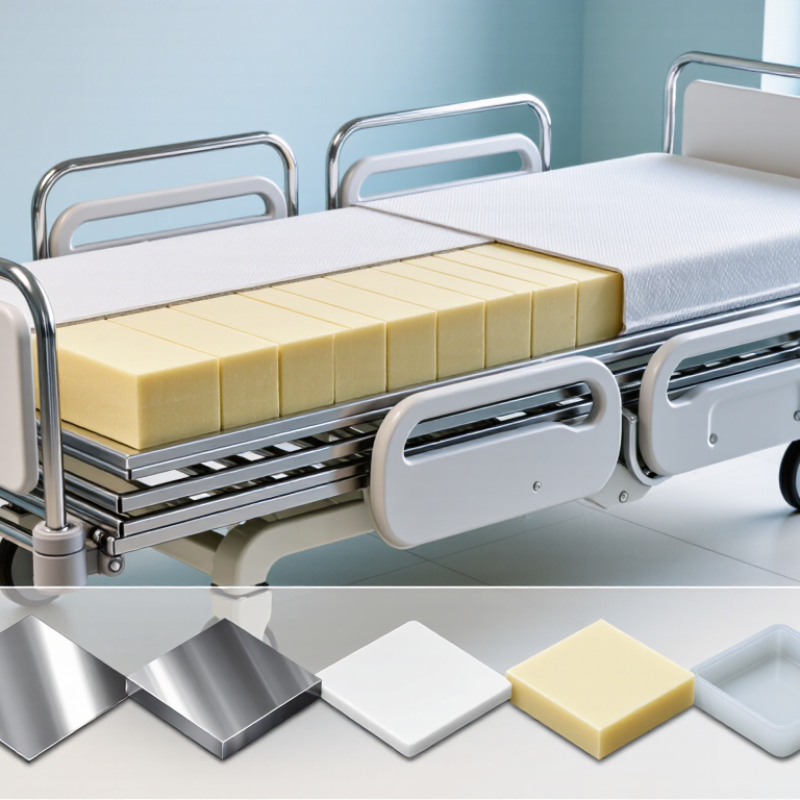
Medical bed materials must support safety, hygiene, comfort, and repeated movement. Steel provides structural strength for frames and lifting mechanisms. Aluminum reduces weight, but it may feel less rigid under heavy loads. Medical-grade plastics are useful for side rails, trays, and control housings. They resist moisture and simplify cleaning.
A 2024 MarketsandMarkets report estimates the global hospital beds market will grow at about 7% annually through 2029. This growth increases pressure on manufacturers to balance durability with production cost. The World Health Organization’s healthcare waste guidance also highlights the need for easier cleaning and responsible material handling. Powder-coated steel can resist corrosion, yet damaged coatings may expose weak points. Plastics are practical, but some become brittle after years of disinfectant exposure. No material is perfect.
Tips: Test materials with real cleaning agents, not water alone. Check welds, joints, and surface gaps. Ask suppliers for biocompatibility, fire-performance, and corrosion-test records. ISO 13485-based quality systems can improve traceability from raw material to finished bed. ASTM testing methods also help compare load strength and durability. In practice, a quiet, stable bed often reflects careful material selection more than expensive components. Design teams should document failures honestly. That part is often missed.
| Material Category | Common Medical Bed Components | Key Functional Role | Important Advantages | Main Limitations | Typical Selection Requirements |
|---|---|---|---|---|---|
| Carbon Steel | Base frames, lifting structures, cross-members, brackets | Provides load-bearing strength and structural rigidity | High strength, widely available, weldable, cost-effective | Can corrode if protective treatment is damaged; relatively heavy | Adequate static and dynamic load capacity, corrosion protection, fatigue resistance, and smooth weld finishing |
| Stainless Steel | Fasteners, exposed fittings, selected frame parts, fluid-contact areas | Improves corrosion resistance and cleanability | Good resistance to moisture and many cleaning agents; durable surface | Higher material and machining cost; heavier than aluminum | Suitable grade for the cleaning environment, crevice-control design, and resistance to disinfectant exposure |
| Aluminum Alloys | Side rails, support structures, transport components, lightweight frames | Reduces overall bed weight while maintaining useful stiffness | Low density, naturally oxide-protected surface, easy to form and machine | Lower stiffness and surface hardness than steel; galvanic corrosion may occur with dissimilar metals | Weight reduction, joint design, surface protection, and compatibility with adjacent metals |
| Engineering Thermoplastics | Bed boards, handles, covers, control housings, cable guides | Provides molded, non-sharp, lightweight protective and functional parts | Low weight, design flexibility, electrical insulation, and good impact resistance in suitable grades | May discolor, crack, or lose strength under ultraviolet light, heat, or incompatible chemicals | Chemical compatibility, flame behavior, impact performance, cleanability, and dimensional stability |
| Polyurethane and Vinyl Coatings | Coated metal frames, handles, panels, and high-touch surfaces | Creates a protective, cleanable, and visually uniform surface | Improves corrosion protection, appearance, and resistance to routine abrasion | Coating damage can expose the substrate; some disinfectants can cause swelling or cracking | Verified disinfectant compatibility, adhesion, abrasion resistance, edge coverage, and repairability |
| Powder-Coat Finishes | Steel and aluminum frame surfaces | Protects metal substrates from routine handling, moisture, and abrasion | Uniform finish, low solvent emissions during application, and broad color availability | Chips and scratches may permit corrosion; coating quality depends on pretreatment and curing | Pretreatment quality, coating thickness, adhesion, edge coverage, and resistance to cleaning chemicals |
| High-Pressure Laminates | Mattress platforms, panels, work surfaces, and decorative boards | Provides a smooth, rigid, wipe-clean surface | Good scratch resistance, easy cleaning, and stable flat surfaces | Unsealed edges can absorb moisture; damaged surfaces may delaminate | Sealed edges, moisture resistance, low-emission substrate, impact resistance, and compatibility with disinfectants |
| Polyurethane Foam | Mattresses, overlays, patient positioning cushions, and arm supports | Distributes body pressure and contributes to patient comfort | Low weight, tunable firmness, cushioning, and broad manufacturing availability | Can retain heat, compress permanently, and degrade if exposed to unsuitable chemicals or moisture | Firmness retention, density, pressure redistribution, moisture management, fire performance, and cover compatibility |
| Medical-Grade Cover Fabrics | Mattress covers, side bolsters, and removable patient-support covers | Forms a hygienic barrier around cushioning materials | Can be fluid-resistant, flexible, weldable, and removable for cleaning | Seams, zippers, and punctures can become contamination or leakage points | Fluid resistance, seam integrity, tear strength, cleanability, breathability where required, and low-temperature flexibility |
| Rubber and Elastomers | Castors, bumpers, grips, seals, gaskets, and vibration-isolation parts | Provides grip, impact absorption, sealing, and quieter movement | Elasticity, noise reduction, shock absorption, and sealing capability | May harden, swell, crack, or leave residue after exposure to incompatible chemicals or aging | Rolling load, floor compatibility, chemical resistance, compression set, aging behavior, and cleanability |
| Engineering Adhesives and Sealants | Panel joints, trim pieces, cable channels, and sealed interfaces | Joins or seals parts while reducing gaps that can collect soil and fluids | Can reduce fasteners, seal irregular joints, and limit vibration transfer | Performance depends on surface preparation, cure conditions, aging, and chemical exposure | Bond strength, biocompatibility where applicable, disinfectant resistance, cure time, and service-temperature range |
Material-selection priorities: structural safety, patient comfort, infection-control requirements, resistance to cleaning and disinfecting agents, durability, fire performance, ease of maintenance, and total life-cycle cost. Final material choices should be validated against the applicable medical-device, electrical-safety, mechanical-safety, flammability, and healthcare-facility requirements.
Stainless steel, carbon steel, aluminum, and sometimes titanium are common choices. Each metal balances strength, weight, cost, and maintenance differently.
It handles routine moisture and cleaning agents well. It suits side rails, supports, and frequently touched parts. However, it adds weight and fabrication cost.
Carbon steel works well for structural frames, lifting columns, and cross-supports. Its stiffness supports heavy loads efficiently. Protective coatings remain essential.
A scratch can expose bare metal to moisture and disinfectants. Corrosion may begin quietly. Regular inspection matters.
Aluminum makes repositioning easier and naturally resists corrosion. However, lower stiffness may require thicker profiles. Thin sections can dent during transport.
Titanium offers high strength and strong corrosion resistance. Its cost usually limits practical use. Impressive performance alone does not justify every expense.
Stainless steel and well-protected steel can suit these environments. Material compatibility with cleaning chemicals must be verified. Humidity changes the decision.
Medical-grade plastic materials can provide smooth surfaces and impact resistance. Their fire behavior and disinfectant compatibility still require checking. Smooth is not always perfect.
Compare samples after repeated cleaning, not only on the first day. Check welds, joints, fasteners, coatings, and moving parts.
Hidden joints may trap residue, and poor welds may weaken after repeated movement. Replacement access also matters. A strong-looking frame can still disappoint.
Medical bed manufacturing depends on carefully selected materials that balance strength, hygiene, patient comfort, safety, and long-term durability. The question of what materials are used in medical bed manufacturing typically includes structural metals such as steel and aluminum, which provide reliable support while allowing different levels of mobility and weight control. These materials may be combined with modern polymers and composites to create lightweight side rails, panels, casings, and protective components that resist impact, moisture, and repeated cleaning.
Other important elements include specialized fabrics, medical-grade foams, and surface coatings. Breathable, fluid-resistant fabrics can improve comfort and help maintain cleanliness, while supportive foams contribute to pressure management and patient positioning. Protective coatings can reduce corrosion and extend service life. Material selection should also reflect the intended healthcare environment, including hospitals, long-term care facilities, home care, and specialized treatment areas, where factors such as infection control, maintenance demands, patient needs, and operating conditions may differ.

 Dgem Medical